Jerusalem’s Lot Volunteer Fire Department
'Salem's Lot: A NovelJerusalem’s Lot Volunteer Fire Department is the town’s local firefighting institution: formally responsible for responding to fires, but in practice also a social club for retired older men. Its modest resources and episodic activity embody a community that remembers catastrophe without expecting catastrophe to return, making the department an important measure of Jerusalem’s Lot’s civic confidence and vulnerability.
Nature and Organization
The department operates within Jerusalem’s Lot’s old town-meeting government, which includes three selectmen, a constable, an overseer of the poor, a town clerk, and a school commissioner. It receives only a token annual appropriation of three hundred dollars, a sum that underscores how little institutional weight the town assigns to emergency preparedness. Its volunteers are mostly old men on pensions, and outside grass-fire season they spend much of their time at the Reliable, telling stories rather than conducting sustained public work.
The department’s volunteer character reflects the wider structure of Jerusalem’s Lot. The town has no Public Works Department, no public water lines, no gas mains, no sewage system, and no municipal light-and-power service. Fire protection therefore exists without the extensive infrastructure that would make it fully effective. The department is a recognizable civic body, but it remains embedded in a town whose services are sparse, informal, and dependent on personal habit rather than modern administrative capacity.
Place in the Town’s Landscape
Jerusalem’s Lot is organized around two principal roads, Brock Street and Jointner Avenue, which cross at right angles and give the nearly circular township the appearance of a telescopic sight. The department’s territory includes sharply contrasting spaces: wooded north Jerusalem, the Royal River and its cliffs, farms and commuter houses in the southeast, and the trailers and shacks of the Bend in the southwest. These areas differ in density, wealth, accessibility, and exposure to danger, yet the same small volunteer institution stands as the town’s common safeguard.
The department’s practical difficulties are intensified by the geography and infrastructure of the place. The southwest Bend contains junked cars, trailers, makeshift yards, and hastily laid septic tanks, while the wooded sections are crossed by old logging roads. The Central Maine Power pylons cut a 150-foot-wide diagonal gash through the timberland, with one pylon standing close to the Marsten House. Roads, woods, electrical lines, farms, and neglected marginal housing form a network in which fire can travel across social and physical boundaries faster than the town’s informal apparatus can respond.
Fire Memory and Public Confidence
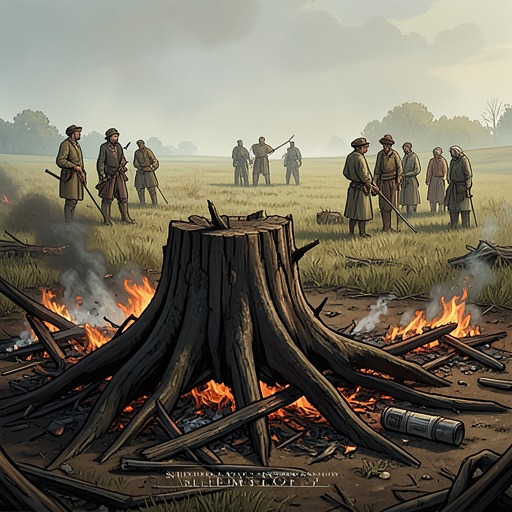
The department’s most important historical reference is the Jerusalem’s Lot Fire of 1951. In autumn, people on Schoolyard Hill can see the department’s small truck waiting in case field burnings get out of hand, and the sight explicitly recalls the lesson of that earlier fire. The residents have not forgotten what uncontrolled flames can do; their readiness is a form of communal memory made visible in a vehicle waiting near the fields.
Yet remembrance does not become sustained vigilance. The department’s three-hundred-dollar appropriation, its pensioner membership, and its social-club atmosphere suggest a town that has converted past danger into local lore. Jerusalem’s Lot believes that nothing too terrible can happen in such a pleasant place. The department consequently represents both knowledge and denial: the town knows fire, but treats it as a seasonal nuisance rather than as evidence that its landscape can suddenly become unmanageable.
Limits of Civic Protection
The department’s role belongs to the ordinary world of grass fires, field burnings, and the accidental emergencies that punctuate rural life. It is not presented as an organization prepared for the supernatural crisis that overtakes Jerusalem’s Lot. The novel’s wider conflict is shaped by a technological and institutional pessimism in which modern systems no longer appear reliably protective: energy resources are diminishing, environmental damage is spreading, and devices once associated with progress can seem dangerous. Against that background, a small volunteer department with limited money and aging personnel cannot function as the confident modern defense imagined in Dracula.
The department’s weakness is therefore structural rather than merely personal. Even the town’s electrical infrastructure is represented as an intrusive cut through the woods, and the nearby pylon looms beside the Marsten House like an alien sentinel. The organization exists within a material environment already marked by pollution, abandoned industry, waste, and fire history. Its emergency mission is real, but the surrounding system offers too little water, power, municipal coordination, or collective foresight to guarantee safety.
Narrative Significance
As a civic symbol, Jerusalem’s Lot Volunteer Fire Department gives the town’s complacency a concrete shape. It is present enough to reassure residents and remembered enough to suggest competence, yet too small and too casual to counter the forces gathering in the Marsten House and spreading through the town. The department’s waiting truck, especially when set against the remembered fire of 1951, becomes an image of preparedness that has not yet become understanding.
Its significance also lies in the contrast between visible emergency and hidden danger. People can recognize smoke, flames, accidents, and the threat of a field burning; they cannot recognize the truth of the vampire outbreak when it begins. During the night of the town’s collapse, houses are lit and people instinctively retrieve religious symbols, but no one understands what is happening, and they avoid looking out their windows. The department belongs to the same doomed civic order: a legitimate response to familiar danger, rendered inadequate when the town’s emergency is concealed, intimate, and supernatural.